Delving into the realm of Commercial Auto Policy Limits, this introductory paragraph aims to provide a captivating overview of the topic, shedding light on the importance of understanding policy limits and how they impact coverage in various scenarios.
Moving forward, we will explore the factors that influence policy limits, the different types of policy limits available, and offer insights on evaluating and choosing the right policy limits for your commercial auto insurance needs.
Importance of Commercial Auto Policy Limits
Understanding commercial auto policy limits is crucial for businesses that rely on vehicles for their operations. These limits determine the maximum amount an insurance company will pay for covered claims, making it essential to have adequate coverage to protect your business from financial risks.
Impact of Policy Limits on Coverage
- Low policy limits may result in insufficient coverage, leaving your business vulnerable to out-of-pocket expenses in the event of an accident.
- Higher policy limits offer more protection and can help cover costs such as medical expenses, property damage, and legal fees.
- Exceeding policy limits could lead to financial strain for your business, as you may be responsible for paying any expenses beyond the coverage amount.
Consequences of Inadequate Policy Limits
- Insufficient policy limits can result in lawsuits and legal liabilities that could threaten the financial stability of your business.
- Without adequate coverage, your business assets and reputation are at risk, as you may struggle to cover the costs of damages and claims.
- Inadequate policy limits may lead to increased insurance premiums in the future, as insurance companies may view your business as high-risk.
Factors Influencing Policy Limits
When determining the appropriate policy limits for commercial auto insurance, several key factors come into play. These factors can vary depending on the type of business, the number of vehicles, and other variables that impact the level of coverage needed.
Type of Business
The nature of the business plays a significant role in determining the appropriate policy limits for commercial auto insurance. For example, a company that operates a fleet of delivery trucks will likely require higher policy limits compared to a business that only uses vehicles for occasional client meetings.
The level of risk associated with the business activities will influence the amount of coverage needed to protect against potential liabilities.
Number of Vehicles
The number of vehicles owned or operated by a business is another crucial factor in determining policy limits. A business with a large fleet of vehicles will generally require higher policy limits to ensure adequate coverage for all vehicles. Each additional vehicle increases the risk of accidents or other incidents, necessitating higher coverage limits to protect against potential financial losses.
Other Variables
Various other variables can also influence policy limit decisions, such as the types of vehicles used, the driving records of employees, and the geographic locations where vehicles are operated. Factors like the value of vehicles, the frequency of use, and the distance traveled can all impact the level of coverage needed.
Additionally, state regulations and industry standards may dictate minimum coverage requirements that businesses must adhere to.Overall, the combination of these factors and others can lead to varying policy limit requirements for commercial auto insurance. It is essential for businesses to carefully assess their specific needs and risks to determine the most appropriate policy limits that provide adequate protection against potential liabilities.
Types of Commercial Auto Policy Limits
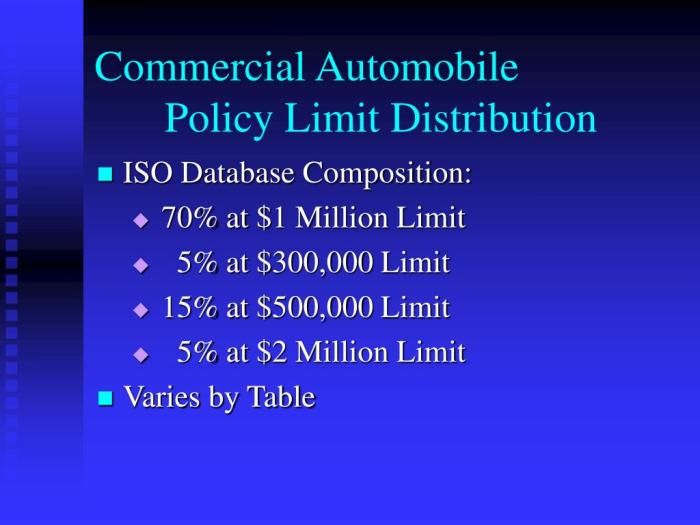
When it comes to commercial auto insurance, there are different types of policy limits that businesses can choose from based on their needs and budget.
Single Limit Policies
A single limit policy provides a fixed total amount of coverage for all liability claims resulting from a single accident. This means that the policy will pay up to the specified limit regardless of the number of people injured or the amount of property damage caused in the accident.
- Advantages:
Provides higher coverage limits for a single event.
Simplifies the claims process as there is only one limit to consider.
- Disadvantages:
May be more expensive than split limit policies.
Less flexibility in allocating coverage between bodily injury and property damage.
Split Limit Policies
Split limit policies, on the other hand, have separate limits for bodily injury per person, bodily injury per accident, and property damage. For example, a policy may have limits of $50,000/$100,000/$25,000, which means $50,000 is the maximum coverage for bodily injury per person, $100,000 is the maximum coverage for bodily injury per accident, and $25,000 is the maximum coverage for property damage.
- Advantages:
Allows for more customization of coverage based on specific needs.
Can potentially provide better protection for different types of claims.
- Disadvantages:
May require more complex claims handling due to multiple limits.
Could lead to coverage gaps if limits are not set appropriately.
Evaluating and Choosing Policy Limits
When it comes to commercial auto insurance, evaluating and choosing the right policy limits is crucial for protecting your business assets and ensuring proper coverage in case of accidents or damages. Here are some best practices and tips to help you determine the adequacy of your current policy limits and select the appropriate coverage for your business needs.
Assessing Current Policy Limits
- Review your current policy limits in detail to understand the extent of coverage provided.
- Consider factors such as the value of your commercial vehicles, potential liabilities, and the cost of repairs or replacements.
- Compare your current limits with industry standards and legal requirements to ensure compliance.
Determining Coverage Needs
- Assess the nature of your business operations and the level of risk associated with your vehicles and drivers.
- Consider the typical driving conditions, distances covered, and the frequency of vehicle use in your business.
- Consult with insurance experts or agents to understand the specific coverage options available for your industry.
Choosing Appropriate Policy Limits
- Calculate the potential financial losses your business could incur in the event of an accident or lawsuit.
- Consider purchasing higher limits if the value of your business assets exceeds the coverage provided by standard policies.
- Evaluate the cost-benefit ratio of increasing policy limits versus the potential risks your business faces.
Summary
In conclusion, understanding commercial auto policy limits is essential for safeguarding your business assets and ensuring adequate coverage. By evaluating the factors that influence policy limits and making informed decisions, you can protect your business effectively.
FAQ Guide
What factors determine the appropriate policy limits for commercial auto insurance?
The key factors include the type of business, number of vehicles, coverage needs, and risk exposure.
What are the advantages of single limit policies compared to split limit policies?
Single limit policies offer simplicity and flexibility in coverage, while split limit policies provide more specific coverage limits for different aspects of a claim.
How can businesses assess their coverage needs to determine the right policy limits?
Businesses can conduct a thorough risk assessment, consider their asset value, and evaluate potential liabilities to determine appropriate policy limits.